
As electric vehicles continue to increase in performance and energy density, battery safety has become one of the most important considerations in battery pack design. While advanced cooling systems are essential for maintaining normal operating temperatures, engineers must also prepare for rare but potentially severe failure scenarios such as thermal runaway.
When a lithium-ion cell enters thermal runaway, temperatures can rise rapidly and the heat generated by the failing cell can spread to neighboring cells through conduction, convection, and thermal radiation. If adjacent cells reach their own critical temperature, they may also enter thermal runaway, creating a chain reaction known as thermal propagation that can compromise an entire battery module or pack.
While advanced cooling systems are essential for maintaining normal operating temperatures and reducing the likelihood of thermal runaway, additional materials are needed to help prevent thermal runaway and protect the battery pack if a failure does occur. These materials perform complementary functions throughout the battery pack, from slowing heat transfer between cells to maintaining enclosure integrity and limiting flame spread during a fire.
To support this multi-layered approach to battery safety, Fujipoly has developed a family of materials specifically designed for battery protection. The portfolio includes an Anti-Thermal Propagation Insulating Sponge, Fireproof Rubber, and Flame Retardant Rubber. Together, these materials address different stages of a thermal runaway event, from delaying heat transfer between cells to maintaining enclosure integrity and limiting flame spread.
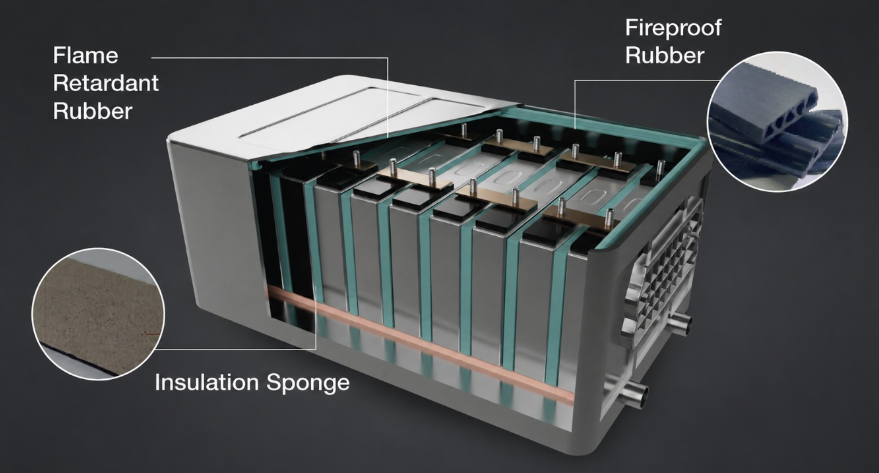
Under normal operating conditions, thermal interface materials are designed to conduct heat efficiently, transferring it away from battery cells and toward cooling systems. During a thermal runaway event, however, the objective changes completely. Instead of encouraging heat transfer, the priority becomes delaying it.
Fujipoly's G1S20488 Anti-Thermal Propagation Insulating Sponge was developed specifically for this purpose. Rather than acting as a thermal interface material, it functions as a thermal barrier that helps slow the transfer of heat from a failing cell to adjacent cells.
The material features a composite construction consisting of thermally insulating outer layers bonded to a resilient silicone sponge. This combination allows it to provide excellent thermal insulation while remaining compressible enough to accommodate battery swelling, manufacturing tolerances, and dimensional variations within the battery pack.
In addition to its thermal performance, the sponge also provides mechanical cushioning, helping absorb vibration and shock that could otherwise contribute to cell damage during operation.
Evaluating insulation materials intended for battery safety presents unique challenges. Conventional thermal interface material test equipment is typically designed for electronics applications operating at relatively modest temperatures. Measuring performance during thermal runaway conditions requires an entirely different approach.
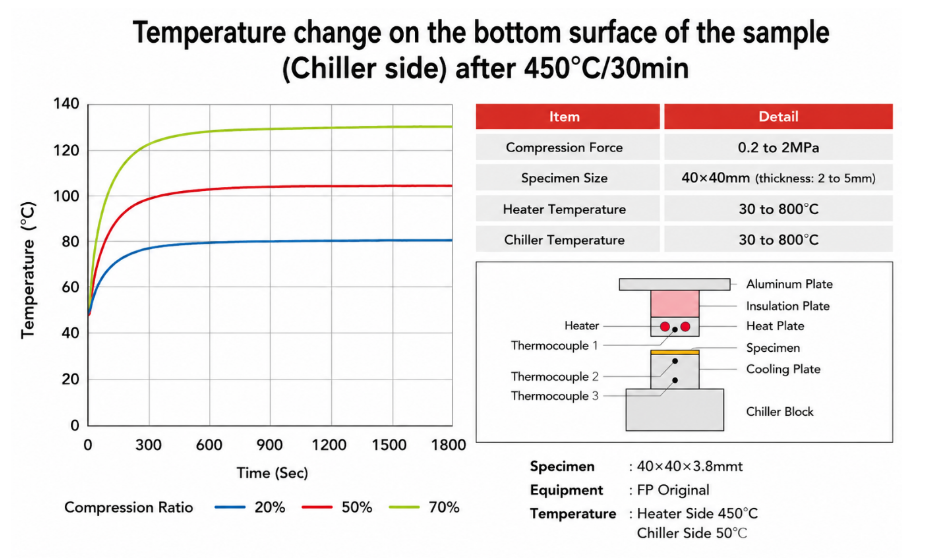
To characterize the insulating sponge, Fujipoly developed specialized testing equipment capable of evaluating thermal performance at temperatures approaching 450°C.
Testing demonstrated that the material maintained a substantial temperature difference between the hot and cold surfaces, even under significant compression. Equally important, the material delayed heat transfer over time rather than allowing temperatures to rise immediately. This transient response can provide valuable time for battery management systems and other protective measures to react before heat spreads to neighboring cells.
The insulating sponge also maintains a low thermal conductivity—approximately 0.13 W/m·K under the tested conditions—making it well suited for applications where resisting heat transfer is the primary objective.
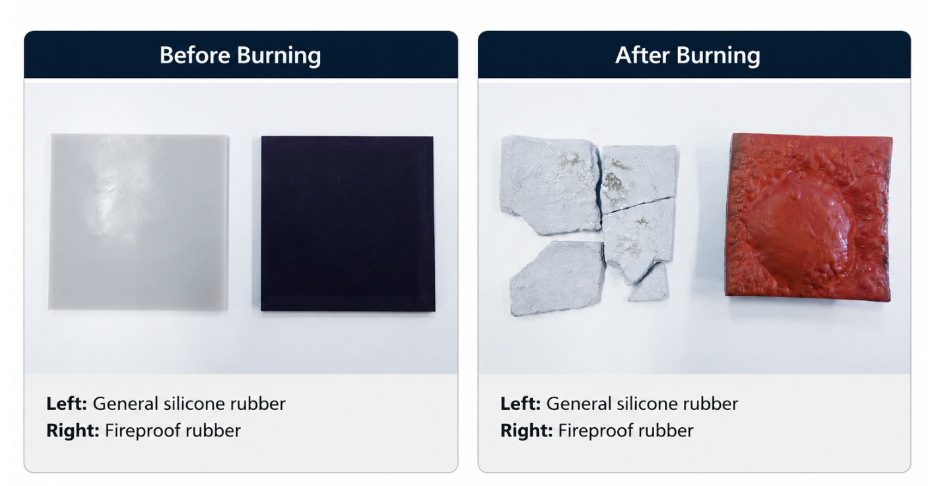
Delaying heat transfer between battery cells is only one aspect of thermal propagation protection. If thermal runaway progresses to sustained fire exposure, materials used in battery enclosures and sealing systems must continue to perform under extreme temperatures.
Fujipoly's Fireproof Rubber is specifically formulated for these conditions. Unlike conventional silicone rubber, which can crack and eventually disintegrate after prolonged flame exposure, Fireproof Rubber undergoes a controlled transformation when exposed to high temperatures. As the material is heated, it forms a rigid ceramic-like structure while retaining its overall shape.
This ceramic-forming behavior allows the material to continue functioning as a physical barrier during a fire, helping preserve the integrity of seals and enclosure components. By maintaining this barrier, it can help limit flame propagation and restrict the movement of hot gases within or outside the battery enclosure.
For battery pack designers, this provides an additional layer of passive protection in applications where maintaining enclosure integrity during a catastrophic failure is critical.
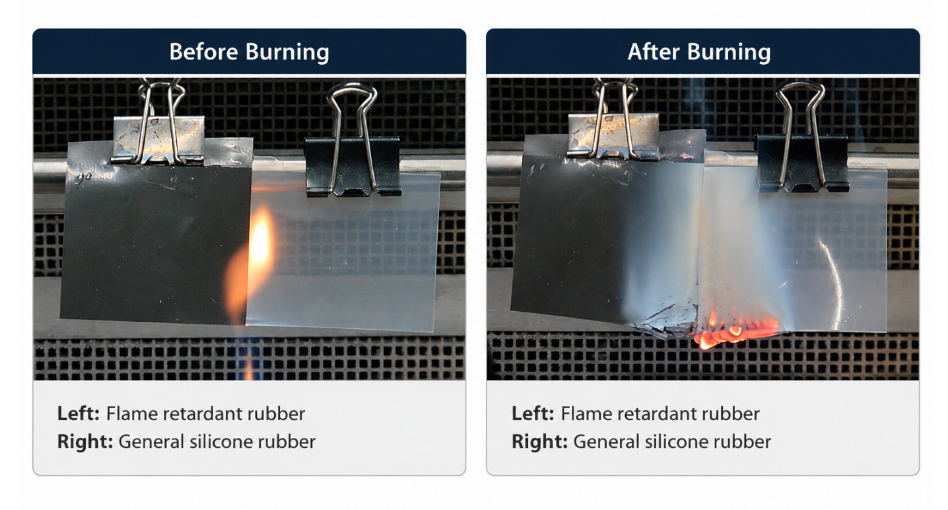
Not every battery pack component requires a fireproof material capable of withstanding prolonged flame exposure. Many components instead benefit from materials designed to resist ignition and limit the spread of flames if a fire occurs. For these applications, Fujipoly offers Flame Retardant Rubber.
This material provides UL94 V-0 equivalent flame-retardant performance. UL94 V-0 is a widely recognized flammability classification indicating that a material will self-extinguish shortly after the ignition source is removed and will not produce flaming droplets capable of igniting nearby materials.
It is important, however, to understand what a UL94 V-0 rating does—and does not—mean. Although a V-0 rated material is self-extinguishing, it is not intended for prolonged direct flame exposure. Extended exposure to extreme temperatures can still cause conventional flame-retardant materials to degrade or lose their mechanical properties.
For this reason, flame-retardant and fireproof materials serve complementary roles within a battery pack. Fireproof materials are intended to maintain structural integrity during sustained fire exposure, while flame-retardant materials help reduce ignition and limit flame spread in components that are not expected to withstand direct flames. Selecting the appropriate material depends on the expected operating conditions and the function of each component within the overall battery safety strategy.
Every battery pack has different mechanical and thermal requirements. Cell format, module layout, enclosure design, and manufacturing process all affect which materials are the best fit.
Fujipoly's anti-thermal propagation materials are designed to adapt to these different battery architectures. The insulating sponge can be die-cut into application-specific shapes for placement between cells or modules, while the rubber materials are available as sheets or precision die-cut parts to match the required geometry.
With decades of experience in silicone formulation, molding, extrusion, and material conversion, Fujipoly also works with customers to develop materials for applications where standard products do not fully meet the design requirements.
Protecting battery systems against thermal propagation requires a layered engineering approach. While cooling systems help maintain safe operating temperatures, additional materials play an equally important role when abnormal events occur. Thermal insulation can delay the transfer of heat between cells, ceramic-forming materials can help preserve enclosure integrity during fire exposure, and flame-retardant materials can reduce the spread of flames throughout the battery pack.
By selecting materials based on the function of each battery pack component rather than relying on a single solution, engineers can build more resilient systems capable of meeting increasingly demanding safety requirements.
With expertise in silicone material formulation and application-specific converting, Fujipoly supports battery manufacturers in developing tailored solutions that enhance thermal protection while accommodating the mechanical and manufacturing requirements of modern EV battery designs.
Our engineering team can help you find the right Fujipoly solution for your specific application. Get in touch to discuss your requirements or request a sample.
Request a Sample