
SARCON® Soft Sheet Thermal Interface Materials are available in two product families: GR Series Gel Type and PG Series Putty Type. Both use thermally conductive ceramic fillers in a soft silicone matrix to provide an effective thermal path between heat-generating components and heat sinks. Their high conformability allows them to accommodate uneven surfaces, component variations, and manufacturing tolerances.
The two families differ mainly in their level of conformability. GR Series provides a good balance of softness, easy handling, and dimensional stability, while PG Series is softer and more conformable, allowing it to fill more complex interface geometries under compression.
Both product families are available as sheets, precision die-cut parts, adhesive-backed materials, and other standard or custom formats. They can be used in both manual assembly and automated pick-and-place processes, making them suitable for a wide range of thermal management applications in electronics, automotive, industrial, telecommunications, medical, aerospace, energy, and other industries.
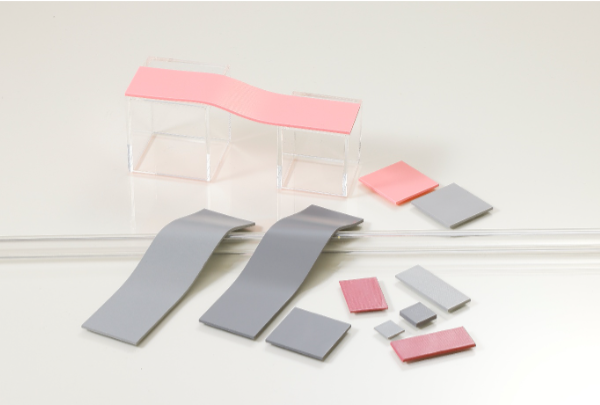
Unlike conventional rubber thermal interface materials, SARCON® Soft Sheet materials are soft enough to conform to uneven surfaces under relatively low mounting pressure. Their silicone structure allows the material to fill small air gaps and maintain close contact with both mating surfaces, helping to improve heat transfer without putting unnecessary mechanical stress on sensitive components. GR Series is available with thermal conductivity up to 13 W/mK, while PG Series reaches up to 15 W/mK, with values measured using the Hot Disk method.
The main difference between the two product families is how they behave under compression. GR Series Gel Type materials are elastic and offer better dimensional stability, making them easier to handle and suitable for applications where workability is important. PG Series Putty Type materials are softer and deform more easily under pressure, allowing them to conform to larger gaps, greater variations in component height, and more complex surface geometries.
Both GR and PG Series are available in a wide range of thermal conductivities to suit different thermal management requirements.
As with all thermal interface materials, overall thermal performance depends not only on thermal conductivity but also on interface thickness, contact pressure, surface flatness, and material selection.
Both product families require significantly lower compression force than conventional rubber gap pads, reducing mechanical loading on delicate components, solder joints, and packages while maintaining reliable thermal contact.
The materials are also formulated to minimize low-molecular-weight siloxanes, improving long-term stability and reducing outgassing in sensitive electronic assemblies.
Both GR and PG Series are intended for applications where low compression force is critical. Typical mounting pressure is provided by springs or enclosure clamping, with many applications achieving effective thermal contact at approximately 30% compression, depending on interface geometry and assembly conditions.
Applications well suited to soft sheet materials include:
Both GR and PG Series permanently conform to the interface after compression, allowing them to eliminate air gaps and maximize surface contact. The primary difference is the degree of conformability. GR Series retains greater dimensional stability, making it easier to handle during assembly, while PG Series is even softer and flows more readily under compression, making it the preferred choice for applications with larger gaps, greater component height variations, or more complex surface geometries.
Our engineering team can help you find the right Fujipoly solution for your specific application. Get in touch to discuss your requirements or request a sample.
Request a Sample