
SARCON® Rubber Type materials are silicone-based thermal interface materials that combine thermally conductive ceramic fillers with a durable silicone rubber matrix. They create an efficient thermal path between heat-generating components and heat sinks while providing reliable electrical insulation and long-term mechanical stability.
Available in rolls, die-cut parts, adhesive-backed materials, gaskets, tubes, and custom molded components, SARCON Rubber Type products can be adapted to a wide variety of electronic and industrial applications.
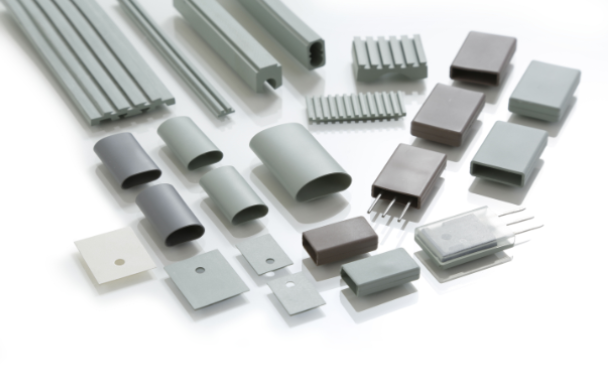
SARCON® Rubber Type materials are designed for applications that require both efficient heat transfer and reliable electrical insulation between heat-generating components and heat sinks. Unlike thermal greases, which are applied as a paste, or highly compliant gap fillers intended to bridge larger tolerances, Rubber Type materials provide a stable, pre-formed thermal interface with a defined thickness and consistent mechanical properties.
Their silicone rubber construction, combined with thermally conductive ceramic fillers, enables efficient heat transfer while maintaining high dielectric performance. Their stable construction provides precise thickness control and consistent performance under clamping pressure, making them well suited to applications requiring repeatable assembly.
SARCON® Rubber Type materials are available with thermal conductivities ranging from approximately 0.9 W/m·K to 3.4 W/m·K, allowing engineers to balance thermal performance, mechanical requirements, and cost. While thermal conductivity is an important parameter, the overall effectiveness of a thermal interface also depends on factors such as material thickness, surface flatness, contact pressure, and interface quality. Selecting the highest conductivity grade does not necessarily result in the lowest thermal resistance, making proper material selection essential.
The materials are designed to perform under mechanical clamping, with thermal resistance decreasing as mounting pressure improves contact between mating surfaces. They are typically secured using screws, clips, or springs that provide consistent contact pressure throughout the product's service life. Their robust construction also simplifies both manual and automated assembly processes.
Low-outgassing silicone formulations improve suitability for sensitive electronic assemblies, while many grades achieve UL94 V-0 flame resistance to support safety requirements in industrial, automotive, telecommunications, and consumer electronic applications.
SARCON® Rubber Type materials are available in both reinforced and non-reinforced constructions to suit different mechanical requirements. Reinforced grades incorporate a woven glass cloth within the silicone matrix, improving tensile strength, dimensional stability, and resistance to tearing during handling and assembly. This makes them particularly well suited for larger sheet formats or applications where the material is subjected to repeated processing. Non-reinforced grades offer greater flexibility and are easier to convert into adhesive-backed parts, die-cut components, and custom-molded geometries. The choice between reinforced and non-reinforced materials depends primarily on the application's mechanical and manufacturing requirements rather than thermal performance.
Our engineering team can help you find the right Fujipoly solution for your specific application. Get in touch to discuss your requirements or request a sample.
Request a Sample